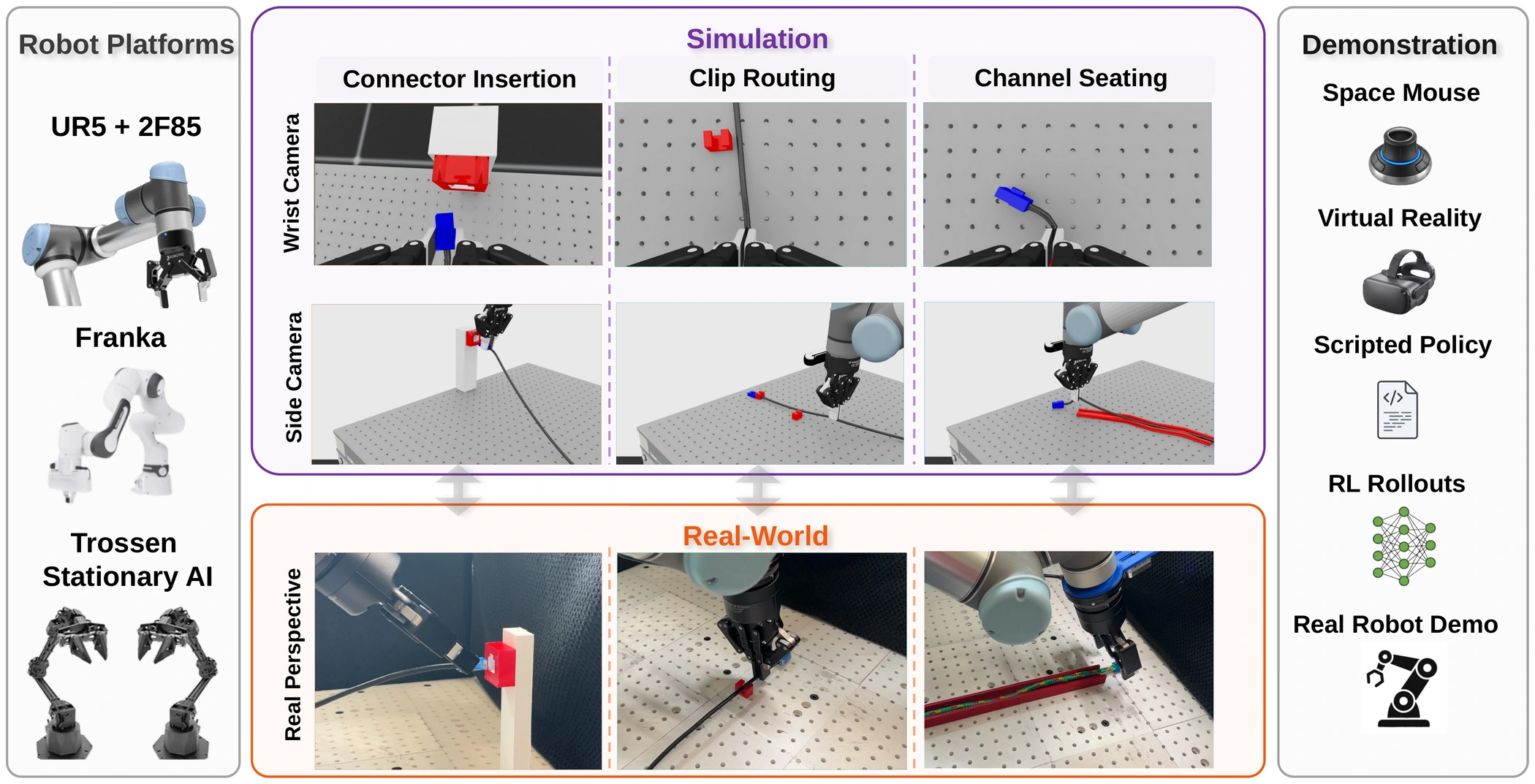
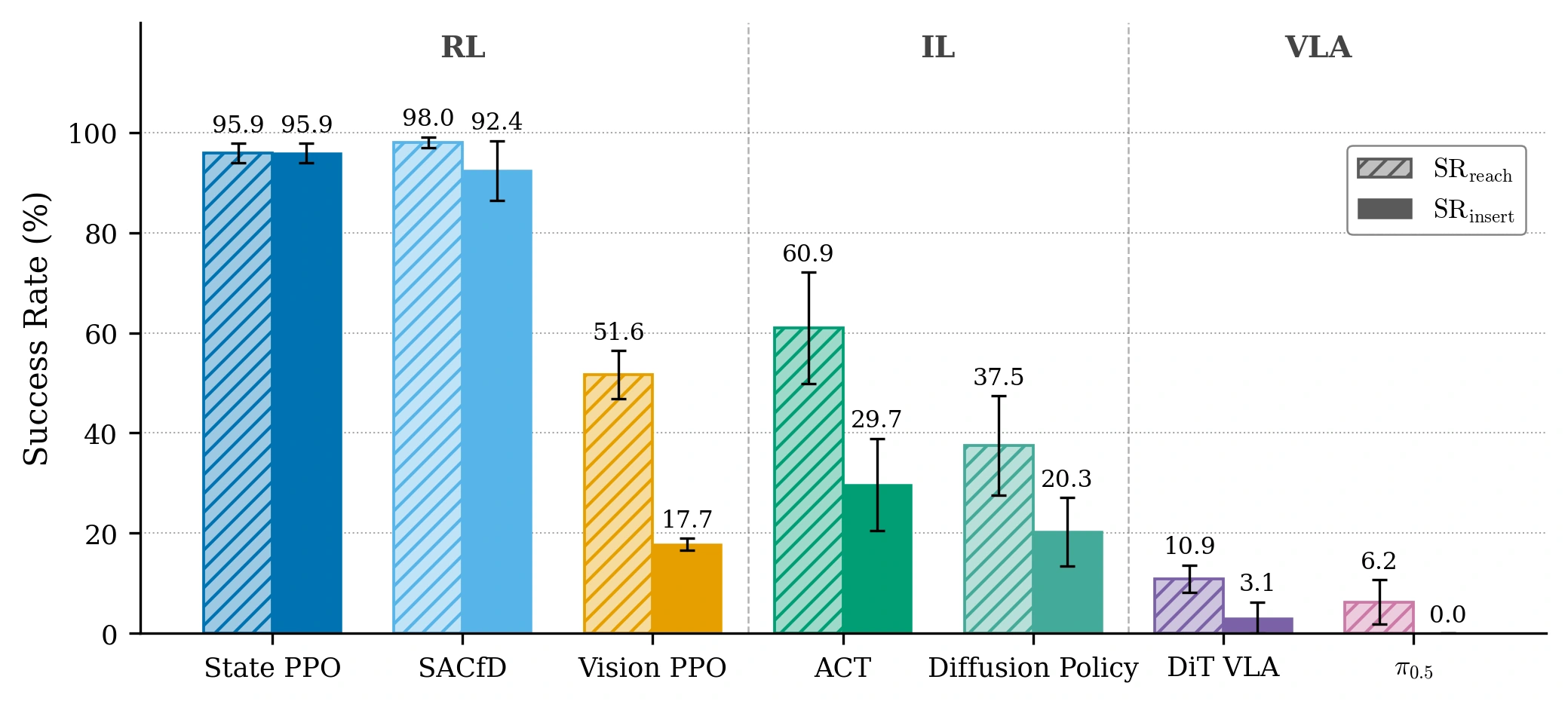
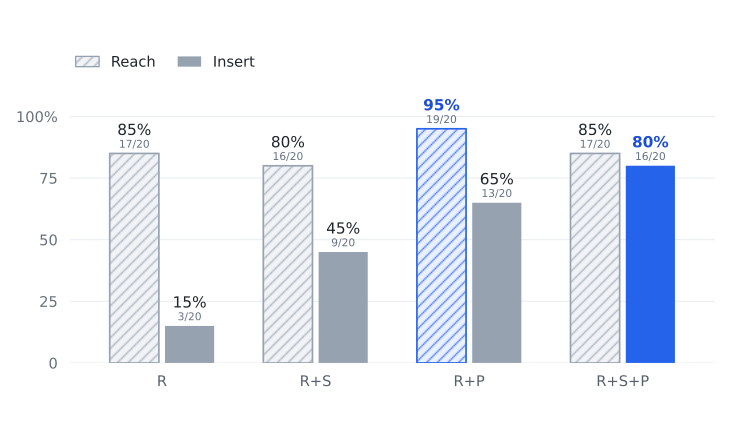
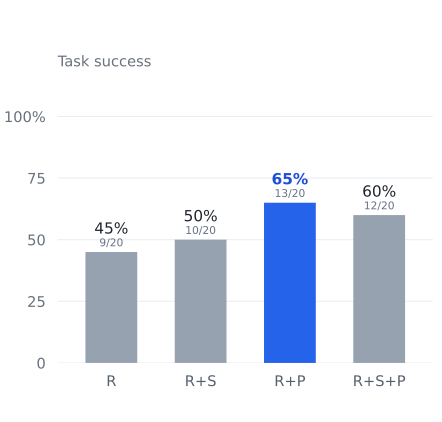
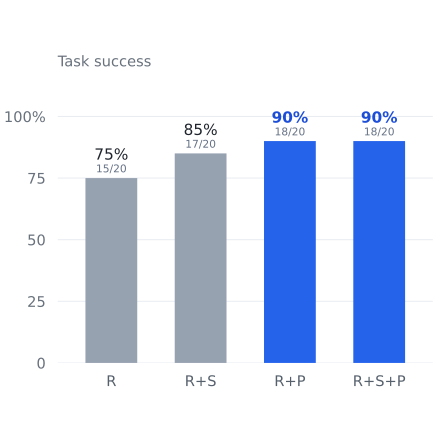
WireCraft benchmarks connector insertion, clip routing, and channel seating in configurable simulation. Privileged state policies exceed 82% success in a representative setting of each task family; image-based policies lag behind. Adding simulated demonstrations improves physical UR5 task success by 15–65 percentage points in the best mixture for each task.
Abstract
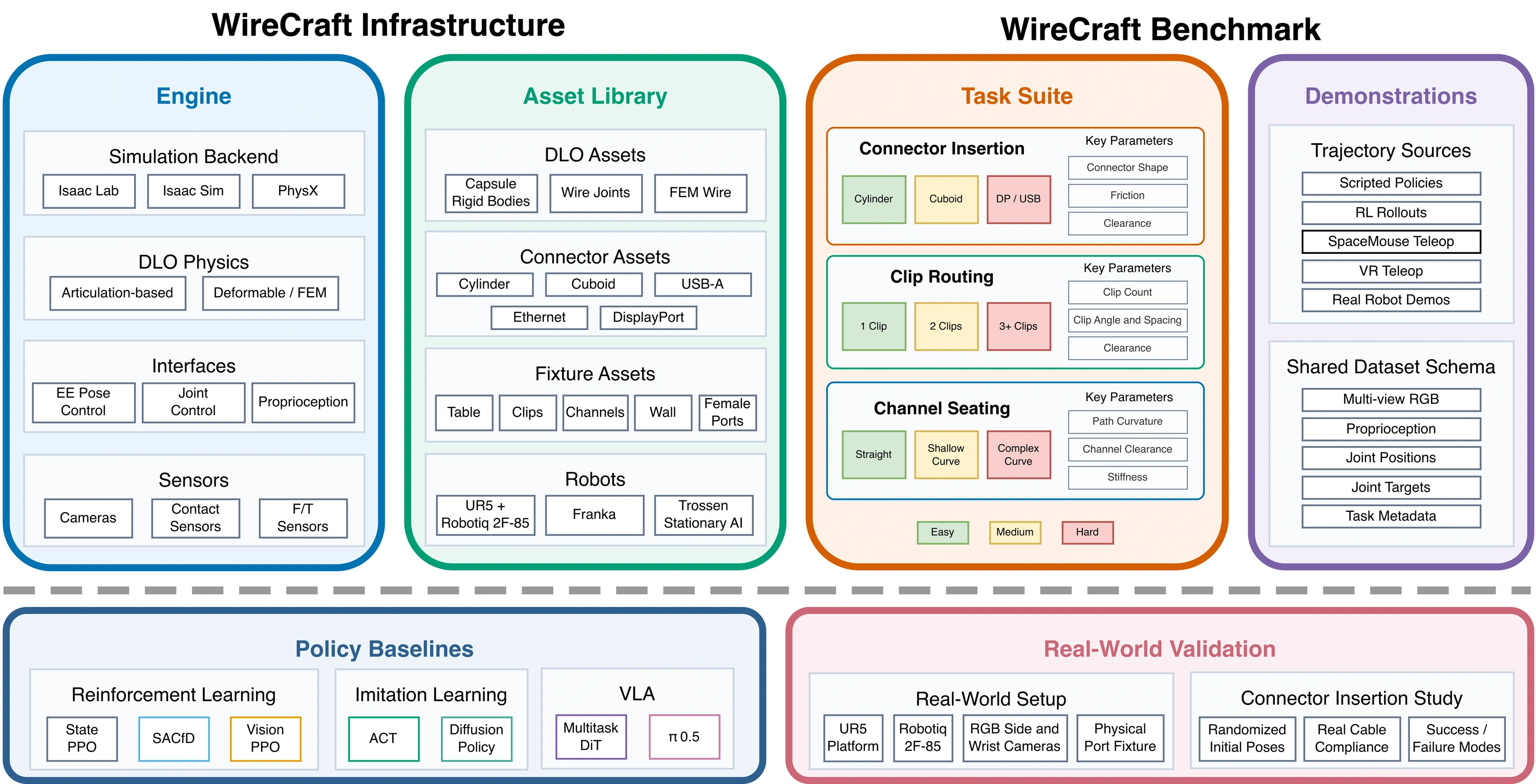
Deformable Linear Objects (DLOs), such as wires and cables, are central to industrial assembly. Unlike rigid objects, whose state is captured by a 6-DoF pose, DLOs have an infinite-dimensional configuration space and deform continuously under contact with grippers, fixtures, and the workspace, making them a demanding benchmark for general dexterous manipulation. Despite their importance, policy development and comparison remain difficult: existing benchmarks are often tied to specific hardware setups, lack modular and customizable task assets, or study generic deformable-object tasks without the fixtures relevant to real-world industrial wire manipulation. Few benchmarks align simulation, real-world data, and shared evaluation protocols. To bridge this gap, we introduce WireCraft, a simulation benchmark for industrial DLO manipulation with configurable difficulty and assets, spanning three task families: connector insertion, clip routing, and channel seating. It supports two complementary DLO physics models, articulated and deformable, and the released trajectories come from both simulation and a physical UR5. We benchmark reinforcement learning (RL), imitation learning (IL), and vision-language-action (VLA) policies under shared metrics. Privileged state-based RL solves a representative setting in each task family with over 82% success, confirming the tasks are well-posed. Image-based policies remain less successful across the evaluated tasks, with ACT and DiT VLA falling below privileged State PPO. On a physical UR5, supplementing real demonstrations with simulated data improves success by 15–65 percentage points in the best-performing mixture for each task. These results indicate that industrial DLO manipulation, though tractable under privileged state, remains an open challenge for current vision-based learning.