RouteRLT.

arXiv 2026 · IROS 2026 IARL Workshop

RouteRLT

Generalists Act, Specialists Intervene: Modular Stage-Selective RL for VLA Manipulation

Chongyu Zhu Hyegang Kim Jaden Hinds Juan Sebastian Rojas Ramy ElMallah Chi-Guhn Lee

Department of Mechanical & Industrial Engineering, University of Toronto

Extended version of our IROS 2026 IARL Workshop paper.

TL;DR Keep the generalist VLA frozen for broad manipulation; let a learned GRU phase coordinator hand control to lightweight RL specialists right when millimeter-level precision matters.

Generalist VLA Frozen default (π_VLA) ACTIVE GRU Phase Coordinator Monitoring state z_t Pickup RL Precision grasp (π₁) Insertion RL 1 mm alignment (π₂) ACTION QUEUE a₁ a₂ a₃ a₄ Streaming VLA chunk Clear on switch PICKUP ZONE 1 mm PORT ZONE PHASE 01 · GENERALIST VLA Approaching connector smoothly...
Read full abstract

Vision-language-action (VLA) models often struggle in the precision-critical phases of multi-stage manipulation tasks. To mitigate this issue, VLA models can be used in conjunction with reinforcement learning (RL) specialists that are specifically trained to handle the precision-critical phases. However, the coordination between the base VLA model and the RL specialists, which dictates when a specialist should take over from the base VLA and vice-versa, remains an open research question. In this paper, we address this gap by introducing RouteRLT, a modular framework that coordinates a generalist VLA, used as the default controller, with designated precision-critical RL specialists. At a high level, our framework trains a phase-aware coordination mechanism that handles handoffs between the generalist and the specialists. We evaluate RouteRLT on the LIBERO and LIBERO-Plus benchmarks, as well as on a physical connector pickup and insertion task. Overall, we find that RouteRLT improves success on LIBERO, and retains net gains on LIBERO-Plus. On the physical task, RouteRLT completes 65.7% of trials, compared with 8.6% for the baseline. Altogether, these results demonstrate that learned coordination builds on generalist VLA capabilities to improve task completion in precision-critical manipulation.

01 / Real-Robot Hardware

Autonomous connector pickup & 1 mm insertion.

Trossen Stationary AI · 1× speed

Trossen Stationary AI · 1× speed · Autonomous Generalist ↔ Pickup RL ↔ Insertion RL handoffs (1 mm port clearance).
65.7%
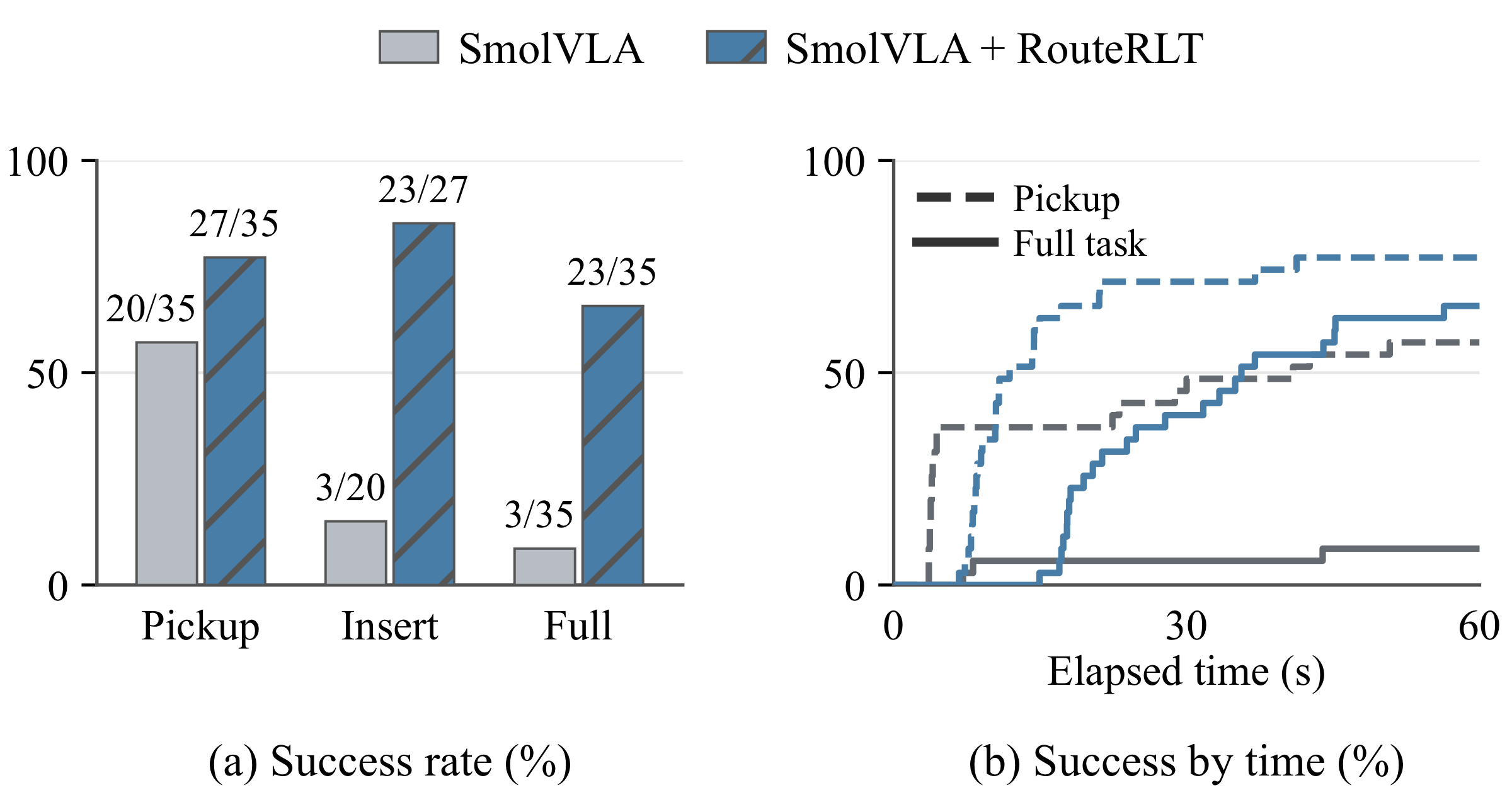
Full-task success (23/35 vs. 3/35 Base)
+57.1 pp
Over frozen SmolVLA (8.6%)
85.2%
Insertion given Pickup (23/27 vs. 3/20)

02 / Re-entrant Control (Real & Sim)

Specialists re-enter whenever needed.

No lockout after exit.

Top
Front
Wrist
Real Robot · Autonomous Re-entry (Trial 017)

Re-entrant Pickup & Insertion on Hardware

Raw 3-camera recording (Top, Front, Wrist · 2× playback): Pickup RL autonomously re-enters after an initial attempt, hands back to Generalist, then Insertion RL seats the connector.
Simulation · LIBERO Long

Multi-Object Reuse & Drop Recovery

Dual-camera replay showing live BASE ↔ PICKUP ownership: one Pickup specialist handles multiple objects and re-enters after a mid-task drop.

03 / LIBERO-Plus Robustness

Zero-shot gains under OOD perturbations.

SmolVLA vs. SmolVLA + RouteRLT

SmolVLA (Base)
SmolVLA + RouteRLT
Background Textures · Zero Retraining

LIBERO-Plus Long — Unseen Tabletop Texture

Same Pickup specialist coordinates repeated pickups under unseen background textures.

SmolVLA (Base)
SmolVLA + RouteRLT
Lighting Conditions · Zero Retraining

LIBERO-Plus Long — Lighting Shift

Phase-aware handoffs remain reliable under strong lighting shifts without retraining.

04 / Architecture

How RouteRLT works.

Full formulation in PDF ↗
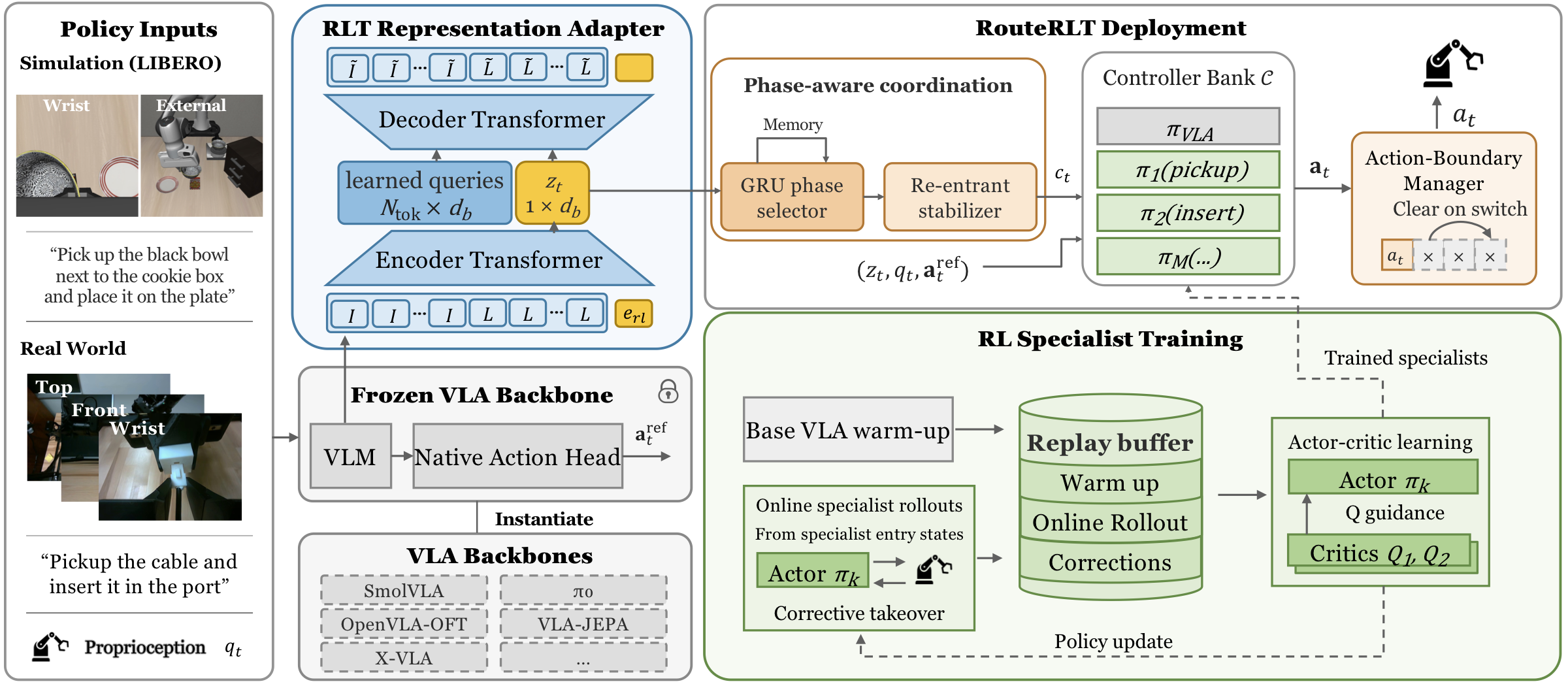
RouteRLT architecture: frozen VLA backbone, RLT readout adapter, GRU phase selector, re-entrant stabilizer, controller bank, and immediate action-boundary flush.
Frozen VLA + compact readout adapter → GRU phase selector & re-entrant stabilizer → immediate action-queue flush on switch.

05 / Key Results

Real hardware, LIBERO & LIBERO-Plus.

Matched episodes · zero retraining on Plus

Real-robot success rates and cumulative completion curves over 60 seconds comparing SmolVLA and SmolVLA + RouteRLT.
Physical connector pickup & insertion over 35 trials (60 s budget): 65.7% vs. 8.6% overall, and 14 vs. 2 completed within 30 s.
Benchmark (SmolVLA)SpecialistsEpisodesBase SRRouteRLT SRΔS2SRec. / Reg.
LIBERO ObjectPickup10093.00%98.00%-1.515 / 0
LIBERO LongPickup (reused)3056.67%70.00%-10.385 / 1
LIBERO SpatialPickup + Place10091.00%94.00%+1.623 / 0
LIBERO-Plus ObjectPickup (0-shot)2,35744.17%47.94%-1.77226 / 137
LIBERO-Plus LongPickup (0-shot)57021.40%25.44%-6.1041 / 18
LIBERO-Plus SpatialPickup + Place (0-shot)2,27440.24%43.76%-2.25172 / 92
More tables: 5 VLA backbones & ablations

Five Frozen VLA Backbones (LIBERO Object & Long)

Backbone (d_b / C)SuiteBase SRRouteRLT SRΔS2SRec. / Reg.
SmolVLA (960 / 10)Object / Long93.0 / 56.7%98.0 / 70.0%-1.51 / -10.385/0 · 5/1
X-VLA (1024 / 30)Object / Long99.0 / 86.7%100.0 / 83.3%+4.23 / +10.831/0 · 2/3
π₀ (2048 / 5)Object / Long97.0 / 93.3%99.0 / 90.0%-0.40 / +5.442/0 · 2/3
VLA-JEPA (2048 / 7)Object / Long100.0 / 100.0%100.0 / 100.0%-1.56 / +1.240/0 · 0/0
OpenVLA-OFTₘ (4096 / 8)Object / Long97.0 / 96.7%99.0 / 96.7%+0.38 / -0.382/0 · 0/0

Key Ablations (SmolVLA Object + Long, 130 episodes)

Variant (SmolVLA Object + Long)Combined SRΔS2SRec. / Reg.
SmolVLA Base84.62%——
RouteRLT (GRU + immediate flush + image & lang)91.54%-3.5510 / 1
Rule-window (privileged geometry)86.92%-0.788 / 5
Chunk-boundary handoff (deferred)86.15%-3.316 / 4
Image-only representation (no language tokens)85.38%-0.227 / 6

06 / Citation

BibTeX

View on arXiv ↗
arXiv:2609.26467
@misc{zhu2026routerlt,
  title = {Generalists Act, Specialists Intervene: Modular Stage-Selective Reinforcement Learning for Vision-Language-Action Manipulation},
  author = {Chongyu Zhu and Hyegang Kim and Jaden Hinds and Juan Sebastian Rojas and Ramy ElMallah and Chi-Guhn Lee},
  year = {2026},
  eprint = {2609.26467},
  archivePrefix = {arXiv},
  primaryClass = {cs.RO},
  url = {https://arxiv.org/abs/2609.26467}
}